
In Brief
Sales training, Sales Development Programs and Sales Academies are often discussed as if they were interchangeable concepts. I do not think they should be.
I find it useful to distinguish between them as follows:
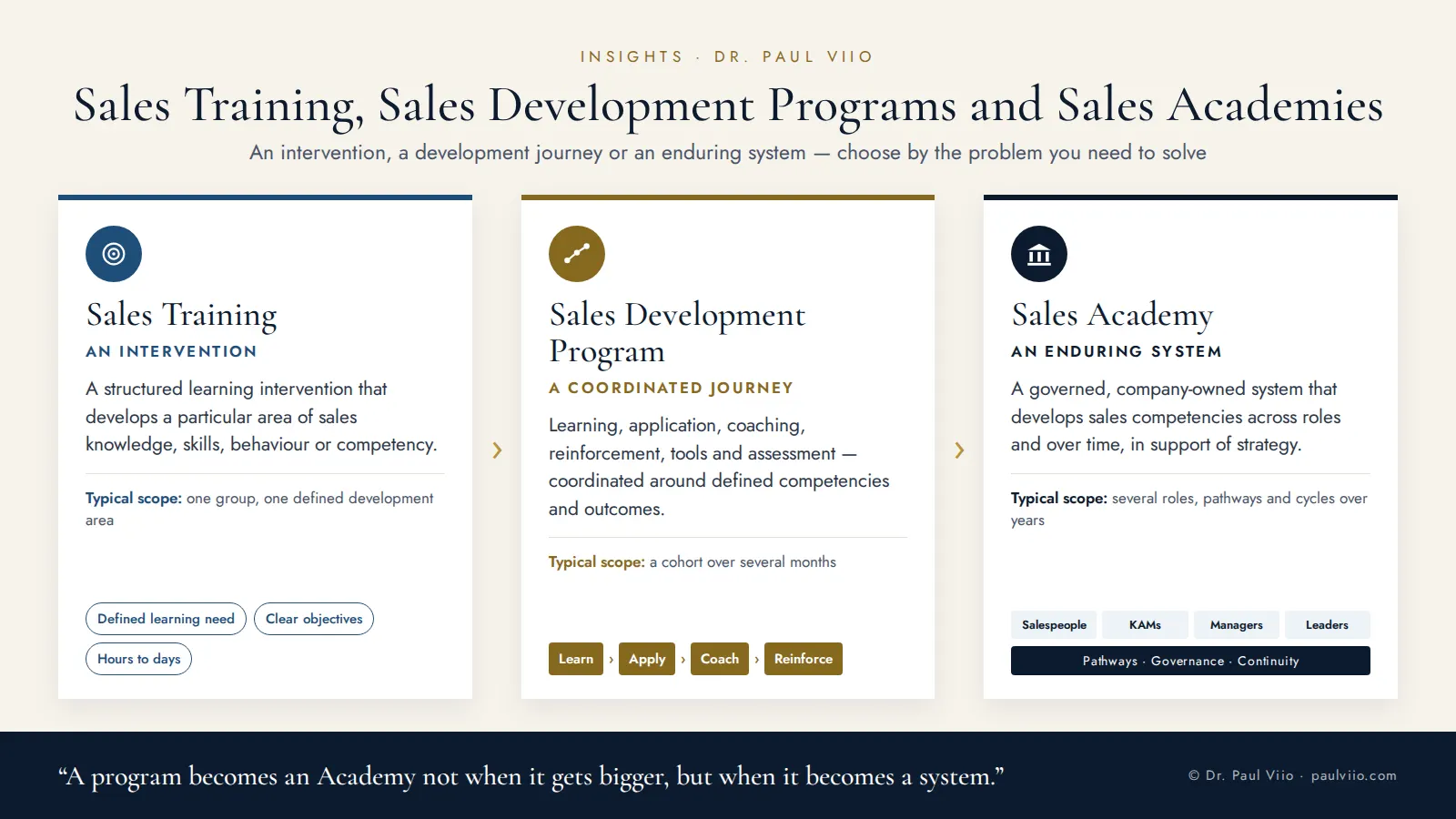
- Sales training is an intervention designed to develop particular sales-related knowledge, skills, behaviours or competencies.
- A Sales Development Program is a coordinated development journey that combines learning, application, coaching, reinforcement, tools and assessment to develop defined sales competencies and contribute to desired sales performance and organizational sales capabilities.
- A Sales Academy is an enduring organizational system for governing and developing sales competencies across roles and over time, in support of the organization's strategy and organizational sales capabilities.
There is, however, an important qualification.
There is no universally accepted scientific taxonomy that formally divides sales development into these three categories. Scientific sales research provides a comparatively strong basis for understanding sales training and how learning transfers into practice. The concepts of a Sales Development Program and particularly a Sales Academy require more synthesis across sales research, training and development research, organizational learning, and established corporate-learning practice.
The definitions in this article are therefore my working definitions, distilled from those different bodies of knowledge.
The distinction matters because the three structures solve different problems.
A company does not need a Sales Academy when focused training would adequately address the need. Nor does a large or long Sales Development Program automatically become an Academy.
A program becomes an Academy not when it gets bigger, but when it becomes a system.
Why the Terminology Matters
Organizations invest significant resources in developing their salespeople. Yet the terminology surrounding sales development remains surprisingly imprecise.
A two-day workshop may be called sales training. A twelve-month learning journey may also be described as sales training. The term sales program can refer to anything from onboarding to a major commercial transformation. And collections of courses are increasingly labelled Sales Academies.
Scientific research does not provide us with a neat three-level taxonomy either.
The sales-training literature has traditionally concentrated on issues such as needs assessment, objectives, instructional design, implementation and evaluation. Attia, Honeycutt and Leach (2005), for example, proposed a three-stage model involving the assessment of salesperson training needs, the effect of training on the trainee, and ultimately its impact on the firm (Taylor & Francis Online).
A comprehensive review by Singh, Manrai and Manrai (2015) similarly found sales-training research spanning assessment, implementation, evaluation and performance rather than a standardized hierarchy of training, programs and academies. Their review covered 56 articles published over three decades (ScienceDirect).
The absence of a universally accepted taxonomy does not make the distinction meaningless.
It does mean that we should be clear about what is supported directly by research, and where we are making a reasoned synthesis for management practice.
That is what I attempt to do here.
My Understanding of Sales Training, Sales Development Programs and Sales Academies
The table summarizes how I use the three concepts.
| Concept | My working definition | Primary unit of design | What distinguishes it | Typical purpose |
|---|---|---|---|---|
| Sales training | A specific structured learning intervention intended to develop particular sales-related knowledge, skills, behaviours or competencies. | Intervention | A defined learning need and structured intervention with identifiable learning objectives | Develop a particular area of knowledge, skill, behaviour or competency |
| Sales Development Program | A coordinated set of learning, application, coaching, reinforcement, tools and assessment activities designed to develop defined sales competencies and contribute to desired sales performance and organizational sales capabilities. | Development journey | Multiple mutually reinforcing development activities organized around defined competencies, participants and outcomes | Develop and embed defined competencies and behaviours over time |
| Sales Academy | An enduring and governed organizational system for developing sales competencies across roles and over time in support of strategy and organizational sales capabilities. | Development system | Competency architecture, pathways, multiple interventions and programs, governance, assessment and continuity | Systematically and repeatedly develop the competencies required by the organization |
My shorthand is therefore:
- Sales training = an intervention
- Sales Development Program = a coordinated development journey
- Sales Academy = an enduring development system
The boundaries are conceptual, not mathematical.
There is no particular number of courses, participants or months at which training suddenly becomes a program—or a program becomes an Academy.
What Does Scientific Research Actually Support?
It is worth separating three levels of evidence.
The sales-training concept has the strongest direct research foundation. There is a substantial body of literature examining training needs, design, delivery, evaluation and performance.
The Sales Development Program distinction is less formally established as a named scientific category. However, extensive research on training transfer and workplace learning supports the underlying idea that sustained competency development depends on more than exposure to a training event. Application, practice, feedback, motivation and the work environment influence whether learning transfers into actual behaviour.
The Sales Academy concept is still more strongly rooted in corporate-learning practice than in scientific sales research. Nevertheless, research into organizational learning provides theoretical and empirical support for the underlying system logic: sustained capability development requires learning structures and organizational conditions that extend beyond isolated interventions.
This distinction is important.
I am not claiming that research has scientifically proven that organizations should organize sales development into exactly these three categories.
I am arguing that the categories provide a useful way of organizing what several established research streams tell us about learning interventions, learning transfer, competency development and organizational learning.
What Is Sales Training?
I define sales training as:
A specific structured learning intervention intended to develop particular sales-related knowledge, skills, behaviours or competencies.
The training might concern questioning, negotiation, opportunity qualification, value propositions, account planning, stakeholder management, customer meetings or another defined development area.
It could last two hours, two days or involve several sessions.
Duration is not what defines it.
The important point is that there is a particular development need and a structured intervention intended to address it.
This is consistent with the scientific sales-training literature. Attia, Honeycutt and Leach (2005) explicitly connect sales training with identifying training needs and assessing both trainee and organizational impact. Singh, Manrai and Manrai's (2015) review similarly shows that assessment, implementation, evaluation and performance have been central themes in the research (Taylor & Francis Online).
More recent work by Attia and colleagues (2021) reinforces the importance of assessing actual learning rather than simply participant satisfaction. Their study suggests that organizations should establish explicit standards for evaluating both reactions to training and knowledge gained (Taylor & Francis Online).
Training can also produce measurable performance effects.
Singh, Sen and Borle (2022), for example, examined an online sales-training program in a field setting and found positive sales-performance effects. Importantly, however, the effects differed across salespeople, regions and products, and some effects diminished over time (Sage Journals).
That latter finding points toward an important issue.
Learning something is not the same as continuing to apply it.
Why Training Alone May Not Be Enough
One of the most established issues in training research is the transfer problem: whether what has been learned is actually generalized to the job and maintained over time.
Baldwin and Ford's classic review defined training transfer in terms of both the generalization of learned material to the work environment and the maintenance of learned behaviour over time. They argued that transfer depends not only on training design but also on trainee characteristics and the work environment (DOI).
More than two decades later, Blume, Ford, Baldwin and Huang (2010) conducted a meta-analysis of 89 empirical studies. Their findings reinforced the importance of factors beyond the training itself, including motivation and a supportive work environment (DOI).
The broader science of organizational training reaches a similar conclusion. Salas and colleagues (2012) emphasize that effective training involves what happens before, during and after the formal intervention rather than simply the quality of the classroom event (Sage Journals).
This has an obvious implication for sales.
A salesperson may leave a negotiation workshop understanding the principles perfectly well.
But what happens afterwards?
- Do they have opportunities to practise?
- Does their manager coach them?
- Are they given feedback?
- Does the sales process support the new behaviour?
- Are the metrics and incentives consistent with it?
- Can the learning be applied to actual customers and opportunities?
Training remains the intervention.
But sustained development increasingly requires an architecture around that intervention.
That brings us to the Sales Development Program.
What Is a Sales Development Program?
The terminology becomes less standardized here.
The term sales program is so broad that I find it of limited value by itself. It can describe training, onboarding, an incentive program, sales methodology implementation or a much wider business initiative.
I therefore prefer the term:
Sales Development Program
I define it as:
A coordinated set of learning, application, coaching, reinforcement, tools and assessment activities designed to develop defined sales competencies and contribute to desired sales performance and organizational sales capabilities.
The key word is coordinated.
A development program is not simply several training sessions placed next to each other.
The different activities should reinforce one another around defined competencies and intended outcomes.
For example, a customer-centric B2B value-sales program might combine:
- an assessment of current practices or competency-development needs,
- facilitated workshops,
- application to actual customers and opportunities,
- field assignments,
- tools and templates,
- coaching by sales managers,
- peer discussion,
- feedback,
- reinforcement sessions,
- and subsequent evaluation.
The scientific literature does not give us a universally agreed definition labelled specifically Sales Development Program. The logic behind such a development architecture is, however, well supported.
Boehm-Fischer, Schmidt and Nachtwei (2022), studying the development of sales executives, found that practitioners viewed practical relevance and time for discussion and reflection as the two most important design factors. Daily business pressures, conflicting existing habits and insufficient motivation were among the most commonly identified barriers to implementation (Sage Journals).
Keeling, Cox and de Ruyter (2020) provide an especially relevant sales example. Studying 383 channel partners, they found that deliberate sales learning—conceptualized through knowledge articulation, codification and certification—worked through deliberate sales practice to affect sales performance (ScienceDirect).
Taylor, Jossberger and Gruber (2024) approach the issue from expertise research. Their exploratory study of purposeful practice in sales identified systematic activities through which successful salespeople work to improve their performance rather than treating expertise as the result of knowledge exposure alone (Taylor & Francis Online).
These studies do not prove my specific definition of a Sales Development Program.
They do, however, support the principle behind it:
Competency development requires more than content delivery. People need opportunities to apply, practise, reflect, receive feedback and adapt.
This is why I distinguish a development journey from an individual intervention.
The Distinction Is Not Simply the Number of Training Days
Suppose an organization arranges five unrelated two-day courses during a year.
That gives participants ten days of training.
But it does not necessarily constitute a coherent Sales Development Program.
Now suppose another organization runs three workshops supported by pre-assessment, customer assignments between modules, manager coaching, peer reflection, practical tools and follow-up evaluation.
It involves fewer classroom days.
Yet it may represent a much more coherent development journey.
The distinction therefore lies primarily in how the development activities are connected, rather than how many of them there are.
This is also consistent with the broader training-transfer literature: learning transfer depends on the combination of the intervention, the learner and the surrounding work environment, not simply on the amount of instruction delivered (DOI).
Competencies Provide a Better Organizing Principle than Courses
There is another reason I prefer the development-program perspective.
Ultimately, the important question is not:
Which courses should participants attend?
It is:
What should they become better able to do?
This suggests starting with competencies and working backwards toward the development activities required.
Recent work by Cardinali, Giovannetti, Hautamäki and Jensen (2025) is relevant here. Their research develops a competency-based curriculum for complex B2B sales around competencies required by contemporary sales roles. Their setting is higher education rather than corporate development, so the findings should not be transferred uncritically. Nevertheless, the underlying design principle is useful: identify the competencies the role requires and construct development around them (Sage Journals).
That principle becomes still more important when we move from one development program toward a Sales Academy.
What Is a Sales Academy?
I define a Sales Academy as:
An enduring and governed organizational system for developing sales competencies across roles and over time in support of strategy and organizational sales capabilities.
The important word is system.
A Sales Academy can contain sales training.
It can contain several Sales Development Programs.
It may include different pathways for salespeople, key-account managers, sales managers, commercial leaders and other customer-facing roles.
It might encompass competency frameworks, assessments, onboarding, coaching, workshops, certifications, development resources and field assignments.
But no single training course or development program is the Academy itself.
The scientific literature on sales training does not provide an established definition of a Sales Academy. This is an area where practitioner and corporate-learning literature is particularly useful.
The Association for Talent Development, for example, explicitly describes a Sales Academy as a structured system consisting of numerous programs that together form a competency framework through which salespeople can be developed over their careers (Association for Talent Development).
McKinsey uses similar logic at the broader corporate-academy level, defining corporate academies as dedicated and integrated initiatives or units for developing and sustaining capabilities aligned with corporate strategy. Its research also points toward competency models, learning journeys, governance and joint ownership between HR and the business (McKinsey & Company).
Huthwaite likewise describes its Sales Academy approach as an ecosystem of interconnected programs, frameworks and development pathways rather than as an individual training program (Huthwaite International).
The terminology varies.
The common idea is that development becomes institutionalized.
That leads to my central distinction:
A program becomes an Academy not when it gets bigger, but when it becomes a system.
Size and Duration Do Not Make Something a Sales Academy
Imagine a multinational organization running a twelve-month value-selling initiative for 1,000 salespeople across twenty countries.
It includes assessments, workshops, coaching and field assignments.
That may be an extensive and well-designed Sales Development Program.
But it is not necessarily a Sales Academy.
If the program has one defined development objective, one lifecycle and a clear endpoint—and the development architecture effectively disappears when the program ends—it remains a program.
Now consider a much smaller organization.
It has identified competencies required in different sales roles. New salespeople follow one development pathway. Experienced key-account managers follow another. Sales managers have their own pathway. Competencies are periodically assessed. Programs are added, modified and discontinued as strategic needs change. Managers participate in reinforcement and coaching. Someone owns the overall architecture and governs its development from year to year.
That organization may genuinely have a Sales Academy, even if it has considerably fewer participants.
The distinction is in:
architecture, governance, continuity, competency orientation and organizational ownership.
Not scale.
Why an Academy Needs Continuity
The Academy differs from a program partly because it continues beyond an individual cohort or development initiative.
This does not mean that individual programs run indefinitely.
They should not.
A value-selling program may be redesigned after two cycles. A negotiation module may be replaced. A new sales-leadership pathway may be introduced. Changes in technology, customer behaviour or strategy may create entirely new competency requirements.
What continues is the development system.
The Sales Academy is intended to be an enduring development system, while the individual programs, cohorts and learning modules within it have defined durations and evolve as the organization's needs change.
Here, organizational-learning research helps us understand the underlying logic.
Hussain and colleagues (2023) found relationships between training and development, organizational learning capability and organizational performance in their study of service-sector organizations. Their research does not test Sales Academies, so it would be inappropriate to claim that it proves the performance impact of an Academy. It does, however, support the broader proposition that development becomes organizationally important when it contributes to the organization's capacity to learn (MDPI).
A systematic review by Giannakos, Mikalef and Pappas (2022) reaches a related conclusion from the perspective of e-learning and organizational learning. Digital learning systems can support flexible learning, knowledge sharing and richer learning flows across organizations, particularly when learning is aligned with organizational practices and evolving competency requirements (Springer).
This provides a useful theoretical bridge from individual learning events toward organizational learning systems.
A Learning Platform Is Not a Sales Academy
This distinction is particularly relevant as organizations increasingly use digital learning platforms.
Technology can be extremely useful.
It can distribute learning, provide resources when needed, support reinforcement, enable knowledge sharing, facilitate assessments and allow people to learn flexibly.
But the existence of a learning-management system containing sales courses does not, by itself, create a Sales Academy.
Giannakos and colleagues' systematic review is useful here because it emphasizes learning flows, collaboration, knowledge sharing and alignment with organizational practices rather than treating technology simply as a content-delivery mechanism (Springer).
The platform can enable an Academy.
It is not the Academy.
The Academy is the organizational system governing what competencies need to be developed, for whom, why, through which pathways, and how development connects with organizational objectives.
Why I Believe the Sales Academy Should Belong to the Organization
This is one point where I want to be explicit that I am stating my view, rather than presenting a universally accepted academic definition.
I believe that an organization's Sales Academy should ultimately be its own.
That does not mean that everything needs to be designed or delivered internally.
External specialists may help create the competency framework, design development programs, deliver modules, facilitate workshops, provide assessments or remain part of the Academy's faculty for years.
But I do not think an organization's Sales Academy should simply be an external training provider's catalogue of courses with the client's logo added to it.
If it genuinely belongs to the organization:
- competency priorities should reflect its strategy,
- pathways should reflect its roles,
- cases should increasingly reflect its customers and markets,
- lessons should accumulate inside the organization,
- managers should participate in development,
- programs should evolve as strategic needs change,
- and the organization should increasingly own the development architecture itself.
This position is also broadly consistent with corporate-academy practice. McKinsey stresses strategic alignment and business/HR co-ownership, while Deloitte describes corporate academies as company-connected systems systematically targeted toward capabilities identified as strategically important by the organization (McKinsey & Company).
External expertise can remain highly valuable.
But the Academy should increasingly become part of how the organization develops itself.
Training, Programs and Academies Are Not a Maturity Hierarchy
A Sales Academy is not automatically superior to a Sales Development Program.
A development program is not automatically superior to training.
They serve different purposes.
Suppose twenty experienced key-account managers need to improve their negotiation competencies.
Focused training, supported by appropriate application and follow-up, may be exactly what is required.
Suppose an organization wants a cohort of salespeople to make a significant transition from product-focused selling toward customer-centric value selling.
That transition is unlikely to occur through a single workshop. A coordinated Sales Development Program involving learning, application, coaching and reinforcement may be much more appropriate.
Suppose instead that the organization needs to develop different competencies among salespeople, KAMs, sales managers and commercial leaders, repeatedly across years and in alignment with changing strategy.
That is when a Sales Academy becomes relevant.
The question is therefore not:
Which solution sounds most advanced?
It is:
Do we need an intervention, a development journey or an enduring system?
What Are We Actually Trying to Develop?
There is an even more fundamental issue underneath all three structures.
What are we trying to develop salespeople to become better able to do?
In my earlier article on Sales Competencies vs. Sales Capabilities, I define sales competency as:
A salesperson's ability to apply and adapt relevant knowledge, skills, behaviours and judgment effectively in a particular sales context.
The words apply, adapt, judgment and context are deliberate.
Competent performance in complex B2B sales is not simply possessing knowledge or reproducing a prescribed technique.
A salesperson has to understand the customer, the customer's business and priorities, the buying stakeholders, decision criteria, relationship history, risks, alternatives, timing, constraints and other elements of the context—and then exercise judgment regarding how to proceed.
My research with Fredrik Nordin on double-loop sales adaptation supports this broader view. We found that sales adaptation can require changes not only in observable selling behaviours but also in the underlying mindset guiding the interaction. In some situations, understanding the customer's circumstances can even lead a salesperson to refrain from selling when the proposed purchase would not appropriately serve the customer's needs.
The point is important for development.
The objective should not merely be to make salespeople better at getting customers to say yes.
It should be to make them better able to understand customers, identify where and how relevant value can be created, adapt appropriately to the situation, and contribute to outcomes that make sense for both parties.
This is why I believe sales development should ultimately be structured around competencies, rather than around a catalogue of training topics.
From Individual Competencies to Organizational Sales Capabilities
Competency development is still only part of the performance equation.
Individual competencies primarily reside with people.
Organizational sales capabilities depend on more.
A company may employ highly competent salespeople and still struggle to execute its sales strategy consistently if its processes, information, leadership, management practices, technology, tools, incentives or organizational routines work against them.
This distinction matters when deciding what intervention is needed.
If the salesperson lacks an important competency, development may be the appropriate response.
But if competent salespeople are prevented from applying what they know by the surrounding organizational system, sending them to another training course may accomplish very little.
That is why I see the relationship as follows:
Sales training can develop a specific area of knowledge, skill, behaviour or competency.
A Sales Development Program can coordinate learning and application around a defined set of competencies and outcomes.
A Sales Academy can govern competency development systematically across roles and over time.
But organizational sales capability requires those competencies to be combined with the organizational conditions needed to apply them effectively, consistently and repeatedly.
How Does This Relate to Sales Enablement?
I therefore do not regard a Sales Academy and sales enablement as synonyms.
Sales enablement is broader.
I define sales enablement as the strategic and cross-functional system through which an organization develops the competencies of its salespeople and provides the leadership, management practices, processes, resources, information, content, tools, technology, coaching and other forms of support required to build and sustain the sales capabilities needed to execute its sales strategy effectively.
Seen through that lens:
Sales training develops particular knowledge, skills, behaviours or competencies.
A Sales Development Program coordinates learning and application around defined competencies and outcomes.
A Sales Academy systematically governs competency development across roles and over time.
Sales enablement connects those competencies with the broader organizational conditions required to convert them into sustainable sales capability.
This also helps explain why investments in learning do not necessarily solve every sales-performance problem.
Sometimes there is a competency gap.
Sometimes there is an organizational capability gap.
Quite often, there are elements of both.
Which One Does Your Organization Need?
I would begin with three questions.
1. What Problem Are We Actually Trying to Solve?
Is there a specific knowledge, skill or competency gap?
Or is performance being constrained by processes, management practices, organizational structure, incentives, information or tools?
If the latter is the case, training alone may address the symptom rather than the cause.
2. How Broad and Persistent Is the Development Need?
Does one group need development in one defined area?
Do people need to change behaviour through a coordinated period of learning, application, coaching and reinforcement?
Or does the organization need to develop different competencies across several roles continuously over time?
3. Do We Need an Intervention, a Journey or a System?
This brings us back to the simplest version of the distinction:
- Sales training = an intervention
- Sales Development Program = a coordinated development journey
- Sales Academy = an enduring development system
None is inherently better than the others.
The appropriate choice depends on the problem the organization is trying to solve.
From Buying Courses to Developing Sales Capability
Perhaps the most important consequence of this distinction is that sales development should not begin with:
Which courses should we buy?
A better starting point is:
What does our strategy require our sales organization—and the people within it—to become better able to do?
That question directs our attention toward competencies.
We can then ask what prevents those competencies from being applied effectively and consistently.
Only after that should we decide whether the appropriate response is an individual training intervention, a coordinated Sales Development Program, an enduring Sales Academy—or changes elsewhere in the sales organization.
That is a more demanding starting point.
But I believe it is much more likely to turn sales development from a collection of learning events into something strategically meaningful.
It also raises the logical next question:
If we build a Sales Academy, should we organize it around courses—or around competencies?
That question deserves further research and clarification, and it may be the subject of a separate article.
Related Reading and Services
- From Sales Competencies to Sales Capabilities: The Role of Sales Enablement – what we develop, and why competencies alone do not make capabilities
- B2B value sales training and sales development programs – focused training or a coordinated development journey
- Sales Academy design and implementation – an enduring, company-owned development system
- B2B sales consulting and advisory – when the gap is organizational capability rather than competencies
References
Academic Research
Attia, A. M., Honeycutt, E. D. Jr., & Leach, M. P. (2005). A Three-Stage Model for Assessing and Improving Sales Force Training and Development. Journal of Personal Selling & Sales Management, 25(3), 253–268. Article / DOI
Attia, A. M., Honeycutt, E. D. Jr., Fakhr, R. A., & Hodge, S. K. (2021). Evaluating Sales Training Effectiveness at the Reaction and Learning Levels. Services Marketing Quarterly, 42(1–2), 124–139. Article / DOI
Baldwin, T. T., & Ford, J. K. (1988). Transfer of Training: A Review and Directions for Future Research. Personnel Psychology, 41(1), 63–105. Article / DOI
Blume, B. D., Ford, J. K., Baldwin, T. T., & Huang, J. L. (2010). Transfer of Training: A Meta-Analytic Review. Journal of Management, 36(4), 1065–1105. Article / DOI
Boehm-Fischer, A., Schmidt, J. T., & Nachtwei, J. (2022). Ears on the Street: Practitioner Opinions on What Competencies Sales Executives Need and How to Develop Them. SAGE Open, 12(4). Article / DOI
Cardinali, S., Giovannetti, M., Hautamäki, P., & Jensen, K. B. (2025). A Competency-Based Curriculum Content Design for Complex B2B Sales in Higher Education Institutions. Journal of Marketing Education, 47(3), 287–305. Article / DOI
Giannakos, M. N., Mikalef, P., & Pappas, I. O. (2022). Systematic Literature Review of E-Learning Capabilities to Enhance Organizational Learning. Information Systems Frontiers, 24, 619–635. Article / DOI
Hussain, A., Khan, M., Rakhmonov, D., Mamadiyarov, Z., Kurbonbekova, M., & Mahmudova, M. Q. K. (2023). Nexus of Training and Development, Organizational Learning Capability, and Organizational Performance in the Service Sector. Sustainability, 15(4), 3246. Article / DOI
Keeling, D. I., Cox, D., & de Ruyter, K. (2020). Deliberate Learning as a Strategic Mechanism in Enabling Channel Partner Sales Performance. Industrial Marketing Management, 90, 113–123. Article / DOI
Salas, E., Tannenbaum, S. I., Kraiger, K., & Smith-Jentsch, K. A. (2012). The Science of Training and Development in Organizations: What Matters in Practice. Psychological Science in the Public Interest, 13(2), 74–101. Article / DOI
Singh, V. L., Manrai, A. K., & Manrai, L. A. (2015). Sales Training: A State of the Art and Contemporary Review. Journal of Economics, Finance and Administrative Science, 20(38), 54–71. Article / DOI
Singh, S. S., Sen, R., & Borle, S. (2022). Online Training of Salespeople: Impact, Heterogeneity, and Spillover Effects. Journal of Marketing Research, 59(1), 230–249. Article / DOI
Taylor, A., Jossberger, H., & Gruber, H. (2024). Purposeful Practice as the Key to Superior Sales Performance: An Exploratory Analysis. Journal of Marketing Theory and Practice, 32(2), 174–190. Article / DOI
Viio, P., & Nordin, F. (2017). Double-Loop Sales Adaptation: A Conceptual Model and an Empirical Investigation. Journal of Business-to-Business Marketing, 24(2), 123–137. Article on ResearchGate
Practitioner and Corporate-Learning Sources
Association for Talent Development (ATD) (2018). Building and Sustaining a Sales Academy. ATD
Deloitte (2025). Corporate Academies: Flipping the Tassel on Traditional Corporate L&D. Deloitte
Huthwaite International. Sales Academy. Huthwaite International
McKinsey & Company (2015). Building Capabilities for Performance. McKinsey & Company
Frequently Asked Questions
What is the difference between sales training and a sales academy?
Sales training is a single structured learning intervention that develops a particular sales competency. A sales academy is an enduring, governed system that develops sales competencies across roles and over time; it can contain many trainings and sales development programs.
What is a sales development program?
A sales development program is a coordinated development journey that combines learning, application, coaching, reinforcement, tools and assessment around defined sales competencies and outcomes, typically for one cohort over several months.
When does a sales development program become a sales academy?
Not when it gets bigger or longer, but when it becomes a system—with a competency architecture, role-based pathways, governance, assessment and continuity that outlive any single program or cohort.
Does my organization need a sales academy?
Not necessarily. Focused training fits a defined competency gap; a sales development program fits a behavioural change for a group over time; a sales academy fits the need to develop different competencies across several roles repeatedly over years.
Why is sales training alone often not enough?
Because learning has to transfer to the job. Research on training transfer shows that practice, feedback, manager support, motivation and the work environment determine whether new behaviour is applied and maintained.
Is a learning platform the same as a sales academy?
No. A learning platform can enable an academy, but the academy is the organizational system that governs which competencies are developed, for whom, through which pathways, and how development connects with strategy.

B2B Value Sales Transformation Expert, Keynote Speaker & Corporate Trainer