
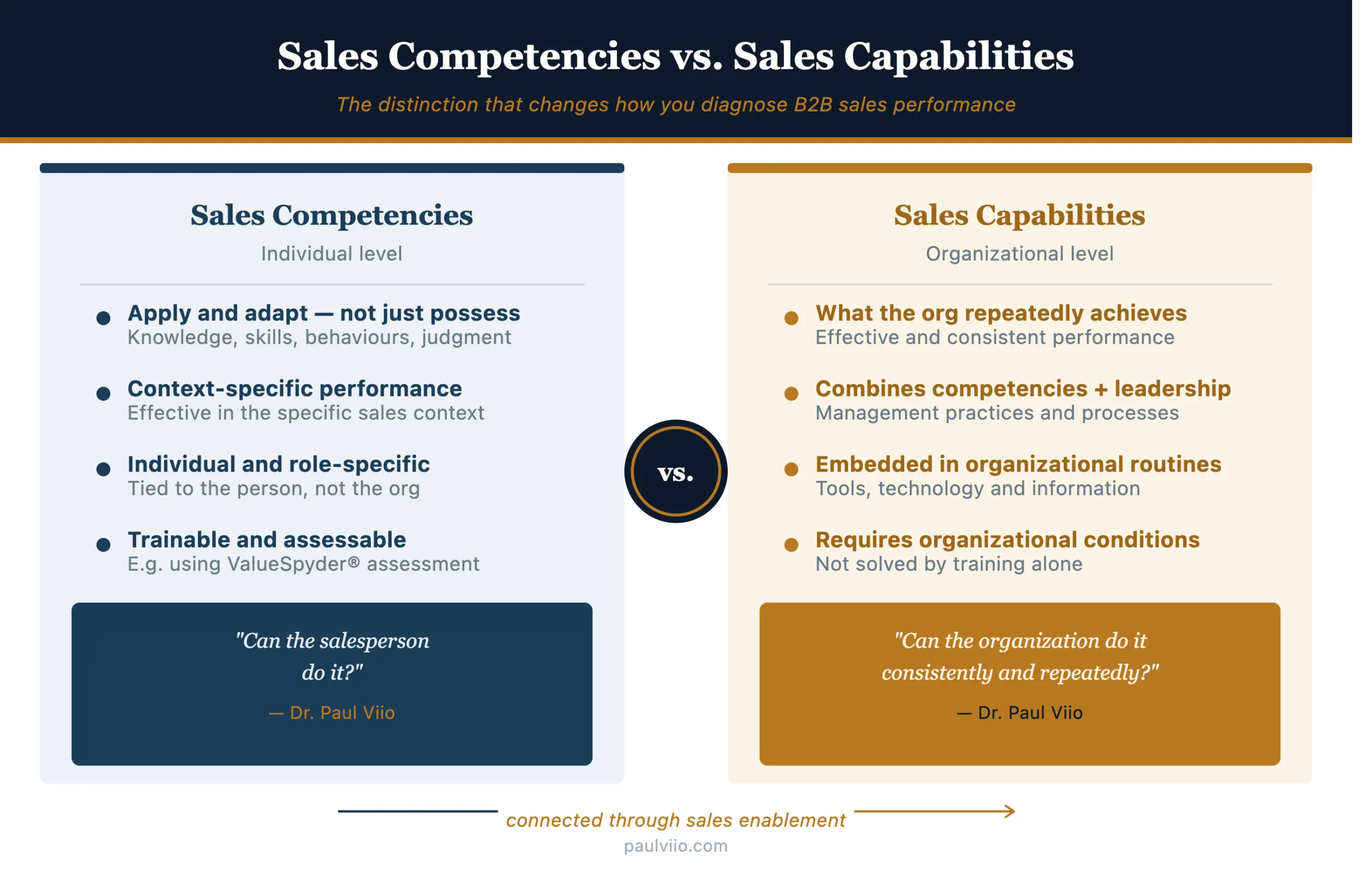
In brief: This article explores why sales competencies and sales capabilities should not be treated as interchangeable concepts, even though they often are treated as such in consulting and practitioner language. Drawing on prior research and B2B sales practice, this distinguishes sales competencies as the salesperson’s ability to apply and adapt knowledge, skills, behaviours, and judgment in context, while sales capabilities refer to the organization’s ability to combine people, processes, resources, technology, leadership, and management practices to achieve desired sales outcomes repeatedly. The key takeaway is that sales performance problems should be diagnosed more carefully and contextually: some are competency gaps, some are capability gaps, and effective sales enablement must connect and support both.
What Is the Difference Between Sales Competencies and Sales Capabilities, and What Does That Distinction Mean for Sales Enablement?
Words do matter. Particularly when they influence how organizations diagnose problems, develop their people, and invest to improve sales performance.
Two concepts that I frequently encounter in discussions with clients and experts related to sales development are competencies and capabilities. They appear in academic research, consulting reports, sales frameworks, competency models, transformation programs, and organizational development initiatives.
What is interesting is how often the terms are used interchangeably. Very often.
An organization may talk about developing its “sales capabilities” when it is primarily developing the knowledge and skills of individual salespeople. Another may build a “sales competency framework” containing not only individual behaviours and skills but also processes, systems, tools, and organizational practices.
Even well-established consulting firms use the terminology differently. McKinsey & Company (2022) discusses “next-generation B2B sales capabilities” while referring to salesperson-level elements such as consultative mindsets, product knowledge, solution design, and account-planning skills. McKinsey: Building next-generation B2B sales capabilities Deloitte, by contrast, explicitly states in its business capability model that a capability should not be confused with a competency. Deloitte describes competency as an individual skill and treats talent and competencies as one of several dimensions contributing to organizational capability, alongside processes, technology, insights, governance, and mission. Deloitte: Configuring the transformation roadmap using the capability model
This does not mean that one organization is necessarily using the terminology correctly and another incorrectly. Rather, it illustrates that practitioner terminology is far from uniform.
But does that mean we should simply treat competencies and capabilities as synonyms?
I don't think so.
If competencies and capabilities mean essentially the same thing, we lose an important distinction between what an individual salesperson is able to do and what the sales organization is able to do effectively, consistently, and repeatedly.
And that distinction becomes particularly important when we consider sales enablement.
Competency Starts with the Salesperson
Competency is sometimes reduced to knowledge or skills. However, knowing something and being able to perform an isolated activity are not necessarily the same as being competent in a complex sales situation.
The European Commission's ESCO framework, which applies the European Qualifications Framework definition, provides a useful distinction between skill and competence. A skill relates to applying knowledge and know-how to complete tasks and solve problems. Competence is broader. ESCO associates it with a person's ability to use and apply knowledge and skills independently when facing new situations and unforeseen challenges. European Commission / ESCO: Competence
This distinction is highly relevant in B2B sales.
A salesperson may understand the principles of value-based selling.
That is knowledge.
The salesperson may know how to formulate and ask effective diagnostic questions.
That is a skill.
But real B2B selling rarely consists of simply reproducing something learned beforehand.
Customer situations evolve. Different stakeholders have different objectives and perceptions of value. Information is incomplete. New information emerges during interactions. A salesperson may need to interpret what is happening, combine different forms of knowledge, adjust the approach, exercise judgment, and sometimes create a response that could not have been anticipated beforehand.
Competency therefore needs to encompass application and adaptation.
I define sales competency as follows:
Sales competency refers to a salesperson's ability to apply and adapt relevant knowledge, skills, behaviours and judgment effectively in a particular sales context.
The words apply and adapt are deliberate.
Competency is not merely about possessing knowledge or having mastered a predefined technique. It concerns the ability to use and adapt what one knows and can do appropriately in the situation at hand.
This view is also consistent with research Fredrik Nordin and I conducted on double-loop sales adaptation (Viio & Nordin, 2017). Viio & Nordin (2017): Double-Loop Sales Adaptation We found that meaningful adaptation in B2B selling goes beyond altering observable selling behaviour. To adapt appropriately, salespeople need knowledge about the buyer and the buyer's situation, while more profound adaptation may also require adjustment of the salesperson's thinking, orientation, and mindset as understanding of the customer develops.
Our research therefore reinforces an important point: effective selling is not simply the application of predetermined behaviours. In complex customer situations, salespeople need to be willing and able to adapt both what they do and, at times, how they think about the situation. Double-loop adaptation involves a more reflective and open approach in which the seller is willing and able to adjust to circumstances rather than merely execute a predetermined selling method (Viio & Nordin, 2017).
Consider a customer meeting involving several stakeholders. A competent salesperson may need to understand the customer's business, recognize different stakeholder interests, ask relevant questions, interpret what is being said—and what is not being said—connect problems with potential business impact, involve internal experts where appropriate, and modify the approach as new information emerges.
There may be no predetermined script for doing this successfully.
Competency therefore involves not only knowledge and skills but also behaviour, judgment, contextual understanding, adaptation, and sometimes creativity.
Capability Moves Us to the Organizational Level
The concept of capability becomes particularly useful when we move from the individual salesperson to the organization.
The organizational capability literature provides a strong theoretical foundation for making this distinction.
Helfat and Peteraf (2003) conceptualize organizational capability in terms of an organization's ability to perform a coordinated set of tasks, using organizational resources, to achieve a particular result. This moves the concept beyond individual ability toward coordinated organizational action. Helfat & Peteraf (2003): The dynamic resource-based view—capability lifecycles
Day (1994) similarly conceptualizes capabilities as organizational phenomena grounded in skills, collective learning, and organizational processes. In his work on market-driven organizations, he identifies capabilities such as market sensing and customer linking and describes capability development in terms of underlying processes, top-management direction and commitment, information technology, and continuous learning and monitoring. Day (1994): The Capabilities of Market-Driven Organizations
Teece, Pisano, and Shuen (1997) make the relationship between competence and capability particularly interesting. Their influential dynamic capabilities framework describes dynamic capabilities in terms of a firm's ability to integrate, build, and reconfigure internal and external competences in changing environments. In their formulation, competences and capabilities are therefore related concepts rather than simply alternative words for the same phenomenon. Teece, Pisano & Shuen (1997): Dynamic capabilities and strategic management
Taken together, these perspectives provide good grounds for distinguishing the two levels.
Competency concerns the salesperson's ability to perform effectively in context. Capability concerns the organization's ability to perform effectively, consistently, and repeatedly.
Based on this distinction, I define sales capability as follows:
Sales capability refers to an organization's ability to combine relevant competencies, leadership, management practices, processes, resources, information, tools, technology, and organizational routines to repeatedly achieve a desired sales outcome.
Individual competencies are therefore an essential component of organizational sales capability.
But they are not sufficient on their own.
Consider Customer Value Selling
Customer value selling provides a useful illustration.
A salesperson may possess strong competencies in understanding the customer's business and situation, identifying relevant stakeholders, uncovering customer problems and opportunities, identifying customer value drivers, quantifying potential customer value, communicating value effectively, and negotiating based on value rather than primarily on price.
Those are individual sales competencies.
But suppose several salespeople in the organization possess these competencies. Does that automatically mean that the company possesses a strong customer value selling capability?
Not necessarily.
Töytäri and Rajala (2015) approach value-based selling explicitly from an organizational capability perspective. Their study examines the organizational capabilities involved in value-based selling and addresses activities including identifying, communicating, and measuring customer value. Putting value-based selling into practice therefore involves more than individual salesperson skill; it also requires organizational capabilities supporting those activities. Töytäri & Rajala (2015): Value-based selling—an organizational capability perspective
The organization may therefore need a shared value-selling approach, customer qualification processes, account-planning practices, customer information, value calculation methods and tools, suitable CRM structures, value proposition frameworks, access to subject-matter experts, appropriate pricing practices, coaching, management support, and mechanisms for documenting and sharing successful customer value cases.
Our research on double-loop sales adaptation provides a similar illustration from another perspective. In the companies we studied, meaningful adaptation sometimes extended well beyond what an individual salesperson could change. It involved adaptations in organizational processes, operations, offerings, and even more fundamental aspects of how the company conducted business (Viio & Nordin, 2017).
This is important.
A salesperson may possess both the willingness and competency to adapt, while the organization may constrain what that salesperson can actually do.
The distinction can therefore be summarized through two simple questions:
Sales competency asks: “Can the salesperson do it?”
Sales capability asks: “Can the organization do it effectively, consistently, and repeatedly?”
That is more than a semantic distinction.
It changes how we diagnose sales performance.
A Capability Problem Is Not Necessarily a Competency Problem
Imagine that an organization concludes that it has a weak customer value selling capability.
A common response might be:
“We need to train our salespeople in value selling.”
Perhaps.
But what if the salespeople already understand value selling and possess many of the competencies required?
The underlying problem could be somewhere else.
Perhaps salespeople do not have access to the customer information they need. Perhaps customer value cannot be quantified because the organization lacks suitable methods or tools. Perhaps the CRM system focuses almost entirely on pipeline stages and revenue rather than customer value. Perhaps sales management reviews concentrate on closing dates and forecasts rather than understanding the value that will be created for the customer.
Perhaps pricing practices encourage discounting. Perhaps incentives primarily reward short-term revenue. Perhaps product management provides feature-oriented sales material rather than evidence of customer business impact. Perhaps managers do not know how to coach value-selling conversations.
Or perhaps leadership communicates that customer value is important while managerial priorities, processes, and reward systems communicate something very different.
In these situations, additional sales training may improve individual competencies without solving the underlying organizational capability problem.
Our double-loop sales adaptation research illustrates this problem particularly clearly. In discussing the managerial implications, we observed that a salesperson attempting to adapt without sufficient support from the company and its management may be able to make only relatively limited adaptations. What the salesperson promises or attempts to do for a customer ultimately needs to be supported by the broader organization and its management (Viio & Nordin, 2017).
Conversely, deeper and more reflective adaptation can contribute to an organization's capability to respond to both minor and major changes in customers' situations and the wider business environment (Viio & Nordin, 2017).
The opposite problem can also occur.
A company may invest heavily in CRM systems, AI tools, processes, sales methodologies, playbooks, content, and analytics—but its salespeople may lack the competencies required to use those resources effectively in customer situations.
The organizational infrastructure exists, but the human competency required to translate that infrastructure into effective customer interaction does not.
Sustainable sales performance requires both.
This Is Where Sales Enablement Becomes Particularly Important
The distinction between competencies and capabilities also helps clarify what we mean by sales enablement.
Sales enablement itself is another term that is not used completely consistently.
The Association for Talent Development (ATD) describes sales enablement as a strategic and cross-functional effort intended to increase the productivity of market-facing teams by providing ongoing and relevant resources throughout the buyer journey. Importantly, ATD's scope extends beyond training to include coaching, content creation, process improvement, talent development, compensation, and other areas. ATD: What is Sales Enablement?
Forrester has similarly emphasized that sales enablement is concerned with ensuring that salespeople possess appropriate knowledge, skills, and process expertise and have access to the assets needed to maximize buyer interactions. Forrester: Sales Enablement—Prioritizing and Executing
These perspectives are useful because they position sales enablement as something broader than sales training.
In some organizations, however, sales enablement still appears to be treated primarily as training. In others, it has become synonymous with providing sales content, technology, or tools.
Both interpretations are too narrow.
If the objective is to enable a sales organization to execute its sales strategy effectively, sales enablement must address both the individual and the organizational dimensions of performance.
Based on the distinction developed above, I define sales enablement as follows:
Sales enablement is the strategic and cross-functional system through which an organization develops the competencies of its salespeople and provides the leadership, management practices, processes, resources, information, content, tools, technology, coaching, and other forms of support required to build and sustain the sales capabilities needed to execute its sales strategy effectively.
This is a synthesized definition rather than one adopted directly from a single source.
It builds on the broader understanding of sales enablement represented by ATD and Forrester while incorporating the distinction between individual competency and organizational capability suggested by competence and capability research.
Seen this way, sales enablement connects competencies and capabilities.
At the individual level, it helps salespeople develop their ability to perform effectively in customer situations.
At the organizational level, it helps create and coordinate the conditions through which those competencies can be translated into repeatable organizational performance.
How the Concepts Relate:
Leadership → sets direction & strategy, creates commitment, and shapes culture.
Management → translates direction into priorities, practices, coaching, measurement, and execution.
Sales competencies → what individual salespeople are able to apply and adapt effectively in customer situations.
Sales enablement → develops and connects people, processes, information, tools, technology, resources, leadership, and management practices.
Sales capabilities → what the sales organization is able to accomplish effectively, consistently, and repeatedly.
This should not be interpreted as a rigid hierarchy. It is better understood as an interconnected system.
Leadership and management influence the environment in which competencies are applied. Sales enablement connects the human and organizational elements. Organizational capabilities emerge when these elements work together sufficiently well for the organization to achieve desired outcomes repeatedly.
Why This Distinction Matters for Sales Leaders
The practical value of separating competencies from capabilities becomes apparent when sales leaders try to improve performance.
Before deciding on an intervention, the organization should diagnose the nature of the problem.
Is there a competency gap?
Do salespeople lack the relevant knowledge, skills, behaviours, judgment, or ability to apply and adapt these effectively to the customer situation?
Or:
Is there a capability gap?
Does the organization lack the leadership, management practices, processes, information, resources, technology, tools, or organizational routines needed to allow competent salespeople to perform effectively and consistently?
Or, as is often the case:
Are both contributing to the problem?
This distinction helps avoid one of the common traps in sales development: assuming that every sales-performance problem can be solved through more training.
Training can be extremely valuable when the underlying problem is a competency gap.
It is considerably less likely to solve problems caused by inappropriate processes, inadequate information, conflicting incentives, unsuitable technology, weak management practices, insufficient leadership, or organizational structures that make effective selling difficult.
Similarly, installing new technology or introducing a new sales process will achieve little if salespeople do not possess the competencies required to use them effectively.
Deloitte's capability model illustrates this systemic perspective well. It treats talent and competencies as only one dimension of organizational capability alongside process, technology, insights, governance, and mission. A capability gap can therefore arise from multiple organizational sources rather than from people's competencies alone (Deloitte, 2025).
Effective sales enablement consequently requires a systemic view of sales performance.
From Individual Competency to Organizational Capability
The distinction can ultimately be expressed quite simply.
Sales competencies reside primarily with people.
They represent a salesperson's ability to apply and adapt relevant knowledge, skills, behaviours, and judgment effectively within a particular sales context.
Sales capabilities reside primarily with the organization.
They represent the organization's ability to combine people's competencies with leadership, management practices, processes, resources, information, technology, tools, and organizational routines to repeatedly achieve desired outcomes.
Neither is sufficient without the other.
Excellent salespeople operating inside a poorly designed sales system may underperform.
Likewise, an organization can invest in excellent tools, processes, technologies, and methodologies but achieve little if its salespeople cannot apply and adapt them effectively in customer situations.
This is why I believe the more fundamental purpose of sales enablement is not simply to provide salespeople with more training, more content, or more technology.
The purpose of sales enablement is to connect individual sales competencies with organizational sales capabilities so that the company's sales strategy can be translated into effective and consistent customer-facing performance.
That proposition is a logical synthesis of the research rather than a definition taken from any individual source.
But I believe it provides a useful way to resolve some of the ambiguity surrounding competencies, capabilities, and sales enablement.
The distinction may appear subtle at first.
For organizations seeking to improve B2B sales performance, however, it can fundamentally change both how they diagnose the problem and which solutions they choose to implement.
About the author Dr. Paul Viio is a scholar-practitioner specializing in customer-centric B2B value sales, sales management, and customer value creation. He combines academic research with extensive work helping B2B organizations develop their sales competencies, sales capabilities, and customer value-focused sales practices.
Putting this into practice: how you develop competencies matters as much as which ones you develop. For the difference between a training intervention, a coordinated development journey and an enduring development system, read Sales Training, Sales Development Programs and Sales Academies: What Is the Difference?. If you want to develop sales competencies systematically across roles, see Sales Academy design and implementation; for focused development, see B2B value sales training and sales development programs. If the gap lies in organizational sales capability—strategy, processes or management practices—see B2B sales consulting and advisory.
References and Further Reading
Association for Talent Development (ATD). (n.d.). What is sales enablement? Association for Talent Development. View source
Day, G. S. (1994). The capabilities of market-driven organizations. Journal of Marketing, 58(4), 37–52. DOI: 10.1177/002224299405800404. View article
Deloitte. (2025). Configuring the transformation roadmap using the capability model. Deloitte. View source
European Commission / ESCO. (n.d.). Competence. European Skills, Competences, Qualifications and Occupations. View ESCO definition
Helfat, C. E., & Peteraf, M. A. (2003). The dynamic resource-based view: Capability lifecycles. Strategic Management Journal, 24(10), 997–1010. DOI: 10.1002/smj.332. View article
McKinsey & Company. (2022, March 15). Building next-generation B2B sales capabilities. McKinsey & Company. View article
Teece, D. J., Pisano, G., & Shuen, A. (1997). Dynamic capabilities and strategic management. Strategic Management Journal, 18(7), 509–533. DOI: 10.1002/(SICI)1097-0266(199708)18:7<509::AID-SMJ882>3.0.CO;2-Z. View article
Töytäri, P., & Rajala, R. (2015). Value-based selling: An organizational capability perspective. Industrial Marketing Management, 45, 101–112. DOI: 10.1016/j.indmarman.2015.02.009. View article and author manuscript
Viio, P., & Nordin, F. (2017). Double-loop sales adaptation: A conceptual model and an empirical investigation. Journal of Business-to-Business Marketing, 24(2), 123–137. DOI: 10.1080/1051712X.2017.1313673. View article on ResearchGate
Whiting, R. (2017, June 5). Sales enablement: Prioritizing and executing. Forrester. View Forrester article
Frequently Asked Questions
What is the difference between sales competencies and sales capabilities?
Sales competencies reside primarily with people. They are a salesperson’s ability to apply and adapt relevant knowledge, skills, behaviours and judgment effectively in a particular sales context. Sales capabilities reside primarily with the organization. They are its ability to combine people’s competencies with leadership, management practices, processes, resources, information, technology, tools and routines to repeatedly achieve a desired sales outcome.
What is the role of sales enablement between competencies and capabilities?
Sales enablement connects individual sales competencies with organizational sales capabilities. At the individual level it helps salespeople develop their ability to perform effectively in customer situations. At the organizational level it creates and coordinates the leadership, management practices, processes, information, tools and technology through which those competencies become repeatable organizational performance, so that the sales strategy can be executed consistently.
Is more sales training the answer to every sales performance problem?
No. Training is valuable when the underlying problem is a competency gap, but it is unlikely to solve problems caused by inappropriate processes, inadequate information, conflicting incentives, unsuitable technology, weak management practices or insufficient leadership. Likewise, new technology or processes achieve little if salespeople lack the competencies to use them. Leaders should first diagnose whether they face a competency gap, a capability gap, or both.

B2B Value Sales Transformation Expert, Keynote Speaker & Corporate Trainer